Builders, Architects, Building Contractors, Interior Designers very often ask for samples of stone or granite that they sense they could be using in their projects.
Over the years, it has so happened that most stone suppliers have also encouraged and adopted this practice of sending samples.
What does this mean? It means that the receivers of samples or prospective buyers actually look at samples and differences between samples of different sellers, and make decisions.
That’s all fine; I raise basic question.
IN THE BUSINESS OF STONE, MARBLE AND GRANITE, WHAT IS A SAMPLE?
Say the slab of a certain type of marble or granite is 8 feet * 5 feet. Means it is 40 square feet of surface area of something is ‘given’ by nature.
If you get a sample of size 6 inches * 6 inches of this marble or granite, does it offer you great idea of the entire slab? Does it offer you a great idea of the entire lot of say 30 or 40 slabs of marble sliced from a block, especially given the fact that this is all nature-created? I am afraid it doesn’t.
Of course, samples are made for surface finishing too. But the efficacy of sampling even for this can be doubted on the very same lines.
And then to think that samples are approved and rejected, and business deals are done, and purchase orders issued…
Builders have been seen to take undue advantage of this extremely flawed process of sampling often. They know it, and they trick the sellers.
And a third pattern that can probably have a balanced mix of the above 2. Let’s call it Mixed Pattern.
Using large slabs of stone, granite or marble in flooring means you are depending on the natural patterns to lend beauty to the flooring and over-all design of the space.
On the other hand, using stone, granite or marble of relatively smaller dimensions in flooring means you are introducing man-made patterns to combine with natural patterns to lend beauty to the design of the space.
Big slabs would disappoint your eyes sooner than latter. Look at the flooring of places you visit carefully.
Have a look at these pictures. This floor was done about 2 decades back. May be more.
This is a view while sitting on the sofa on this very floor.
Now check this picture taken from a height.
Amazing isn’t it! The architect did a such fine job of defining the boundaries of the drawing-room space. Non-rectangular! Organic. Has a charm. Never tiring.
Those border lines, with winding-vine like look, are done in stone. That’s right! Such neat hands. Takes an artist to do such stuff. KARIGARI!
Here’s one more picture, again taken from a height, at a slightly different angle:
On the extreme right, a couple of steps above, is the dining space.
As charming as this floor is, it took a lot of patience on the part of the house-owner along with others, to see it through. Do you have patience to create a beautiful floor for your house?
Once you get such a beautiful floor done, it would dictate the choice for other elements of interior design of the house. And floor doesn’t allow the bar for quality and artistry go any lower.
Get in touch with Mr. G S Soni Mobile: +91 98250 15546
Customer is king (or queen). And every single person is a customer. Even the seller is a customer, except in his own business.
A young couple, Mr. Arav Tiwari and his wife, visited us with a sample of granite and their kadiya’s notes. Here’s a pic of kadiya’s notes:
What do you notice, right from the words at the top to measurements till the bottom?
Basis these notes and a granite sample brought by the Tiwaris, a conversation took place to understand the requirements; Mr. Tiwari’s wife took greater lead in the conversation.
Mr. G S Soni, my father, made an estimate of the total basis the requirements. Here’s a pic of that estimate:
In both the above pieces of paper, notice the words CHOKDI PATHAR. It’s a trade name for Kota Stone which all the people, who deal with masonry and stone-related work, understand and use in their every day language.
There was a discussion related to Granite to be used as Service Counter Top. Granite named Z Brown Red was finalized for this purpose.
Notice that the price for Chokdi Pathar is lower. And that for granite is higher.
A full advance payment of Rs. 3500, against an estimate of Rs. 3561, was made towards the order.
Below is the delivery slip when the order was dispatched:
Upon receiving the material, Mr. Tiwari’s wife got upset seeing CHOKDI PATHAR (Kota Stone). A conversation ensured and my father offered to replace the CHOKDI PATHAR with some other stone or granite as preferred. Mr. Tiwari’s wife wrote nasty things on Whatsapp and left a nasty feedback too on Google. Screenshot below:
Low quality? I’ve written about assessment of quality in other posts. Trying to make sense of quality once again.
Firstly, Mr. Tiwari’s wife can’t claim ‘low quality’. Quality in stone is not related to the prices of the stone.
Chokdi Pathar and Granite are two different things. Just because the price of granite is higher doesn’t mean that it is superior to Kota Stone, that is also called Chokdi Pathar in such contexts.
In fact if one goes about carefully observing the use of natural stone, granite looks worse than Kota Stone in so so many cases. Architects have fancied and used Kota Stone more beautifully than granite, more often than not. But of course, that depends on person to person and design to design.
Italian Stone, in terms of quality, often fails in Indian conditions, even though it looks beautiful, and carries a huge huge price.
Typically, going by how construction-related work happens, and the language used in that work, granite isn’t called and used as Chokdi Pathar. It is always Kota Stone.
In case one uses granite as Chokdi Pathar, one needs to specify and write that explicitly. And pay the price accordingly since granite is priced higher.
One may also have to look at the thickness of the granite slab in case it is used at a spot where some heavy duty work happens. Greater the thickness, greater the price.
Construction-related execution, or any subject that is relatively new for us, demands a careful look at the details.
What does one do in such cases? How should one treat such customer-queens and kings?
Aha! I am curious now. Because of this scandal of opulence, what is going to happen? Will Dior Pearl White marble from Vietnam become more popular in India?
I picked this picture of Dior Pearl White marble from a website. Have a look.
At K. K. Stones Ahmedabad, you are going to get only Non-Kejriwal stone. So far that’s the status. That doesn’t mean that you won’t get beautiful stone. Indian white marble is also exquisite.
There are 2 things you must be particular about:
Limiting the size of the stone tile
Staying patient while the mason lays a neat floor for you
When doing up a house, typically customers look for huge slabs of stone as a measure of beauty. We recommend smaller slabs or tiles of stone and the mason’s work as a measure of beauty.
Get in touch with Mr. G S Soni Mobile: +91 98250 15546
More and more folks buying flats are buying big slabs for flooring. If ‘flat’ the word weren’t this bad, now there’s enough done to ensure flatness in the look of a flat too.
Slabs ensure that the flat achieves its flatness. Wisdom would suggest, “Reduce the flatness from this flat”.
What would you do to reduce the flatness? Hire an interior designer?
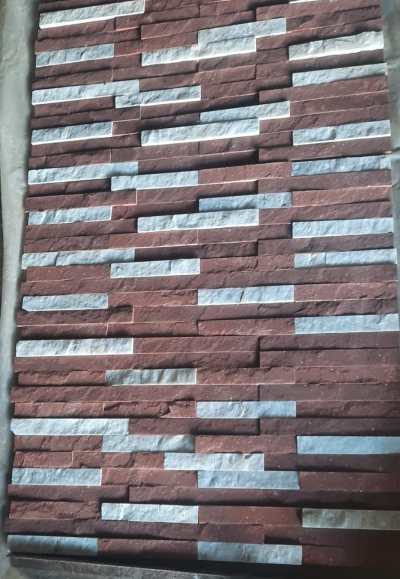
Some more pictures from a work-in-progress… Teakwood stone walls would never tire you. Natural and artistic in its own way. More of Ahmedabad’s walls and buildings covered with Teakwood stone would be pleasant to see.
And then this is how these panels get packed for delivery. We have to send them carefully.
Get in touch with Mr. G S Soni Mobile: +91 98250 15546
Here’s a picture of square 4′ * 4′ Kota Stone flooring.
Don’t mind the picture quality. Perhaps shot indoors with a mobile phone. Besides, it is always difficult to photograph floors or flooring, no matter the design or patterns. You never get the height you desire; and creating perspectives are to show attractive flooring indoors are so difficult. Remember, floors are for the soles of your feet and for your body in space, more than for your eyes.
The hues of Kota Stone are so consistent. Beautiful gradient even when hues differ.
Get in touch with Mr. G S Soni Mobile: +91 98250 15546
Dealing with Big Architects, Purchase Managers at Corporate Construction Companies and their Quality Checkers becomes quite awkward on occasions.
When you contact them, often they ask for ‘samples’.
The thing about samples is, for certain kinds of stone or granite, samples may be fairly representative. 100% representation is just not practical and not reliable either. But for most kinds of stone or granite, samples may just not be representative.
Stone, granite, marble are taken out of quarries. Quarries are god’s gift or nature’s gift. They are not factories. They are a storehouse of nature’s abundance, not man-made products.
The insistence of bulk users of natural stone on adherence to ‘samples’ is unreal; no supplier can control that sort of thing. The magic lies in how to compose architectural looks and interior designs with what nature has gifted us with.
Of course, sometimes ‘non-adherence to samples’ is used as a reason to pay less or not pay at all to the supplier. That is malafide intention, trickery, charlatanism.
Can you tell for sure that a 6″ * 6″ sample is a representative of a lot of 4000 sq. ft. of stone or granite. It is ridiculous. More ridiculous since stone dazzles through its variation not through its uniformity.
Here’s a video of work-in-progress of flooring being done in a room at a farmhouse. The same floor is getting done in all the rooms.
River-finished stone in brown color. Size is 1600 mm * 1200 mm and thickness is in the range of 22 mm to 30 mm. Have a look below. It’s short.
Someone who has different ideas may want a glossy floor. But the point to remember is that as much as floor and interior design is meant for the eyes, it is equally meant for your soles of your feet and for your body to feel good in.
Get in touch with Mr. G S Soni Mobile: +91 98250 15546
A pic of work-in-progress, paving cobbles for pathway for a residential society.
Not sure if the picture gives you an exact idea of the color of these cobbles. They are brown. In the language of stone, brown may be slightly different from what one understands in other contexts.
Size: 150 mm * 150 mm on the surface side, thickness 40 to 60 mm.
Somewhat similar to cobblestones are flagstones; they are mostly irregularly shaped and have bigger surface area. If someone attempts flagstone flooring indoors, should make that space ever-attractive.
Get in touch with Mr. G S Soni Mobile: +91 98250 15546
Machines are slicing bigger and bigger blocks of marble and granite, and creating huge slabs.
Looked in isolation these huge slabs look grand. Typically these slabs are stacked vertically in the stockyard, so eyes look at them as if looking at a wall or painting on a wall.
If the flooring area is huge, these slabs may look alright as floor under your feet. But if the flooring area is a typical flat, you are in for a space-scrunching feeling.
When you are out to buy marble or granite for flooring, check the floor space available between the walls demarcate the floor space. And then divide it by the number of slabs or piece of flat marble or granite you have in mind.
For example if the space is 20′ * 15′, then you get 300 sq. ft. of space for flooring. If you wish to use slabs of 8′ * 2’6″, that means each slab covers 20 sq. ft. of flooring space. So 15 slabs will cover your entire floor.
Instead of 15 slabs, try imagining 45 slabs. There you have a floor worth looking at.
To argue or debate further regarding the aesthetics of big slabs vs small slabs, we are available at our office.
Get in touch with Mr. G S Soni Mobile: +91 98250 15546
This is installed in a boundary wall at a public park.
Reminiscent of classic, ancient, old-time designs that live for hundreds of years. At plenty of places over the years, folks have installed cement grills because they come cheap, but are they any match to this? Even in this work-in-progress pic it looks so charming.
Are you working on a bungalow project? Or a farm-house project? You think these could look beautiful in your space and architectural plans?
If I didn’t show the entire profile of this piece of stone, you may even mistake it for actual wood grains.
Exquisite for wall-cladding. Would fill the space with warmth. Mind you, you got to use lights in the range of 3000 to 4200 Kelvin. I suppose, your architect or interior designer would take care of that.
Can be used as a table-top too. You would never get bored.
The other day I visited an acquaintance’s house. In their drawing room, I noticed a wall fully covered with shiny glossy marble. Looked Italian to me. I guess it wasn’t back-lit, may be in the evenings it could be.
In my conversations with Dad, I often remark, “It has become a fashion market” and its variations.
Even as I write, I am meditating on the meaning of ‘It’ in the above remark.
What is ‘It’?
It = The entire category of Stone Industry?
That doesn’t sound and feel right. And yet, house-design does follow certain styles, fads and fashion, and making choices related to stone is a part of the designing process. So it may not be wrong to call it fashion.
Typically fashion has been linked to garments and clothing. In which other areas, do we see ‘fashion’? Cars? Automobiles in general. Furniture design, typically sofas and beds. I see that in ceiling-design too.
Coming back to stone, well it can’t be fashion. Stone, unless crushed, has a timeless sort of, almost an unchanging presence and look.
Think about it. Garments, one changes almost every day or every other day; some folks do have an unchanging look and they have multiples of the same garments to keep that unchanging look.
You can’t change stone. I mean, theoretically you can but in terms of possibilities and probabilities, you don’t. Stone changes its hues ever so slowly, but that’s that. Nothing radical.
And yet, since stone (I include marble and granite also in stone for the purpose of this post) appears in different colors, it does lend itself to some sort of fashion.
At some point, white marble was a craze. Some time back grey granite and stone was in greater demand. For a couple of years and continuing, brown granite and stone looks to be more popular.
Just as a wardrobe tends towards a palette, colors in the house would tend towards a palette too if you observe and make notes carefully. It would be worthwhile to think in terms of color palettes for your house or interior design and then look at colors of individual elements like sofa color, wall color, floor color et al.
Get in touch with Mr. G S Soni Mobile: +91 98250 15546
If you don’t like blank interior walls, you have a few options to do them up:
Textured Wall Paint
Mural
Framed Painting
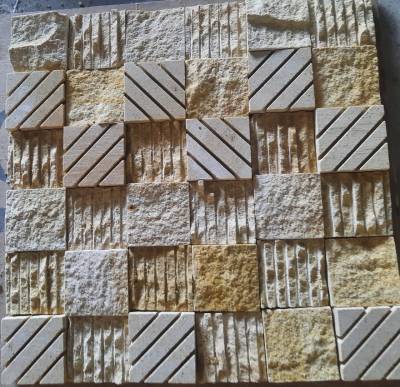
K. K. Stones’ Natural Stone Decor Panels
Funny shiny backlit translucent Italian or some other marble
Thank God, there’s no vitrified tiles for such walls. Well, bathroom walls are done up with vitrified tiles these days. Limit them to bathrooms, please. So far so good.
For blank exterior walls, what do you have? If the walls are under a shade, all of the above may work. But if the walls are exposed to all kinds of elements, these handcrafted stone decor options may feel good.
Like them?
Get in touch with Mr. G S Soni Mobile: +91 98250 15546
For some reason, often, I find such sights of work-in-progress more enchanting.
The great thing about these handcrafted natural stone mosaics is a sense of repetition but with subtle variations. Exact repetitions, as happens in printed vitrified tiles, are recognized instantaneously and are often quite jarring to the eyes.
How is this for your floor? If not indoors, then what about outdoors? Can you appreciate the surface finish of these multi-sided irregular stones?
I’ve observed that plenty of rooms are floored with the same kind of gigantic rectangular slabs of stone or marble, irrespective of the size of surface area to be floored.
Big slabs are faster and may be easier to lay, and therefore quite easily, also quite ugly to look at. The other day I was at someone’s place in Shahibag, Ahmedabad, and they’ve put huge glossy slabs on the walls! Alright!
One measure for those who are getting their interior/exterior design done:
Size of the surface area of the floor / Size of a rectangular slab (or stone piece)
The the greater the result, the better you would feel when the floor is done.
For example, if the room is 15ft * 12ft, and the slab size is 6ft * 2.5ft, it will take just 12 slabs to floor the entire area. Now think if the stone size is 1.5ft * 1.5ft, it will take 80 stone-pieces to floor the area.
Which is a better option? 16 or 80? For your eyes? For your feet? For creative floor surfacing? For the long term?
Builders and building contractors give us orders for supply of truck-load of granite and marble and natural stone. The give us orders based on ‘samples’ that we show them. They approve the sample. By approval of sample, it means that the supplier has to supply the same quality in every slab of granite. What is quality?
What is quality? Is it uniformity?
Can a certain quantity of natural stone be represented through ‘a sample’? How can anyone in the world guarantee adherence of different slabs of granite to one ‘approved sample’?
Is ‘approved sample’ a perfect piece of granite or stone?
In natural stone and granite, you won’t be able to come to any great understanding of quality. Because of its very nature it is impossible to standardize the quality beyond the physical dimensions of slabs or stone. No matter the sample, you are not going to get identical looking granite or stone.
Even if one assumes that slabs and pieces of stone can be sorted and grouped strictly based on certain parameters, the cost of sorting is prohibitive.
Based on the purchase order, when the material ordered reaches the site, the builders and building contractors and their employees at the site engage in ‘quality checking’. The understanding of ‘quality’ is at best vague, unspecified and unclear, but since there is an ‘approved sample’, these clients offer all kinds of reasons to ‘reject’ the material that’s delivered.
Costs of handling natural stone are so high that all such rejections crush the supplier financially.





You must be logged in to post a comment.